
Maine Farmed Seafood Coalition’s New Campaign Puts Farmers First


4 February 2026
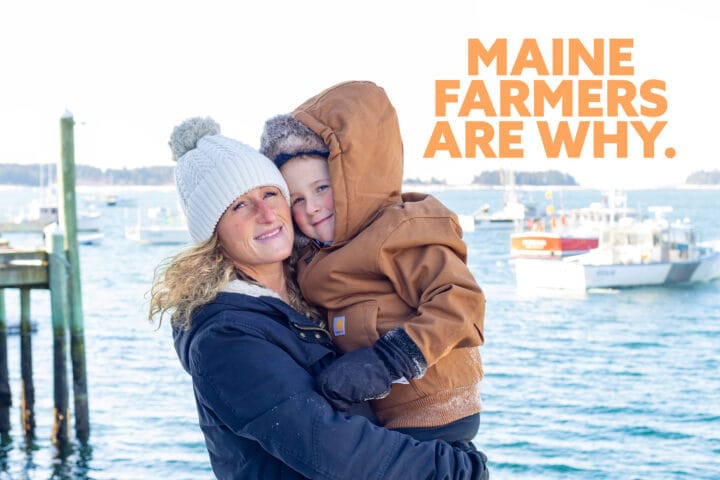 Sea farmer and lobsterwoman Krista Tripp and her son Sebastian. Photo: Jack Sullivan, Maine Aquaculture Association
Sea Farming Coalition Mobilizes to Tell their Story
Maine Farmed Seafood Coalition’s New Campaign Puts Farmers First
The Maine Farmed Seafood Coalition (MFSC) is launching a campaign to educate the public about Maine aquaculture, an effort to address recent sea farming disputes in isolated Maine coastal communities. The campaign, titled “Maine Farmers Are Why,” puts sea farmers at the front of the conversation and tells the stories of innovators who make a diversified living on the coast of Maine.
Krista Tripp is one such sea farmer. She is a member of the MFSC, a commercial lobsterwoman, the mother of a four-year-old boy, and a lifelong Midcoast resident. Having grown up fishing for lobsters with her father, Tripp has spent her career continuing that family tradition. In 2018 she decided to start a second business, Aphrodite Oysters, her four-acre sea farm in South Thomaston. She runs the business, employs three full time workers for most of the year, and continues to fish 800 lobster traps.
“There’s always uncertainty in the wild-caught fisheries, so I went into oyster farming,” Tripp says, “I wanted to pass something on to the future generations. My son Sebastian is growing up alongside the business and can get into oyster farming when he’s older if he chooses to.”
According to 2023 data from the USDA and the US Department of Commerce, at least 80% of seafood consumed in the United States is imported—the majority of that is farmed abroad. The global demand for farmed seafood is continuing to grow, and Maine’s cold clean coastal waters produce premium seafood. Additionally, Maine’s skilled maritime workforce and working waterfront infrastructure make the state an optimal location for sea farming. The Maine Farmed Seafood Coalition recognizes this potential to bring seafood production and consumption close to home and identified the public’s lack of aquaculture knowledge as a barrier to the acceptance and growth of the industry in Maine coastal communities.
Andrea Cianchette Maker, president of FocusMaine, sits on the MFSC steering committee along with representatives from Maine Aquaculture Association, World Wildlife Fund, Coastal Enterprises Inc., and the Island Institute. Cianchette Maker notices a promising trend regarding the potential for public education.
“The more people learn the facts about aquaculture,” she explains, “the stronger their support for it is. This campaign will help Maine people understand and appreciate the tremendous value aquaculture provides to our state, economically, ecologically and culturally.”
A 2024 Maine Aquaculture Association poll cites that 76% of all Mainers identify Maine aquaculture products as a sustainable food source, but that number increases to 82% among Mainers with pre-existing familiarity with aquaculture. The “Maine Farmers are Why” campaign, which will include digital and print storytelling, advertising, as well as in-person events, will amplify stories of Maine farmers and their products, increase the public knowledge and perception of the industry, and aims to broaden overall support.
“Maine has always transformed its economy, largely by creating new products out of its natural resources,” Cianchette Maker says, “Aquaculture is another adaptation and an extension of our fishing heritage. It’s my hope that through this campaign, our aquaculture products grow to become iconic Maine foods, the same way we hold up our lobsters, our blueberries, and our potatoes.”
Each season, Krista Tripp methodically scales up her sea farm and teaches her son how to work on the water. Meanwhile, the neighboring communities of Cushing and South Bristol are inching closer towards an outright ban on commercially viable aquaculture. Both towns could pass ordinances in March that would ban aquaculture operations over half an acre. To many like Tripp who have invested time, labor, and capital into their sea farms, a ban on farms larger than one half of an acre means a ban on profitable aquaculture businesses. Aphrodite Oysters’ total lease size is just shy of four acres, and Tripp claims that they only recently became a consistently profitable business. By comparison, according to the 2022 USDA Census of Agriculture, the average size of a land farm in Maine was 174 acres.
According to Tripp, the maritime “side hustle” should hardly be a foreign concept to coastal Mainers since reoutfitting boats for additional fisheries is a longstanding tradition. “Many lobstermen I know have already diversified what they’re fishing for,” she says, “Aquaculture is another way to diversify.”
Tripp continues, “People just don’t know what we’re doing out there. When there’s a new industry in their area, people feel a lot of fear around it, and they picture a worst-case scenario. We’re not trying to take over the Gulf of Maine. We’re just trying to make a living on the water.”
~~~
About Maine Farmed Seafood Coalition:
The Maine Farmed Seafood Coalition is a collaboration between over 40 sea farms, seafood businesses, and other related organizations. The coalition was formed in 2025 to serve as a collective voice, tell the stories of sea farmers, and educate the public about aquaculture’s contributions and potential to Maine’s economy and culture.
For more information, or to line up interviews with sea farmers,
contact Jack Sullivan
207-239-4852
jack@maineaqua.org
mainefarmedseafood.org
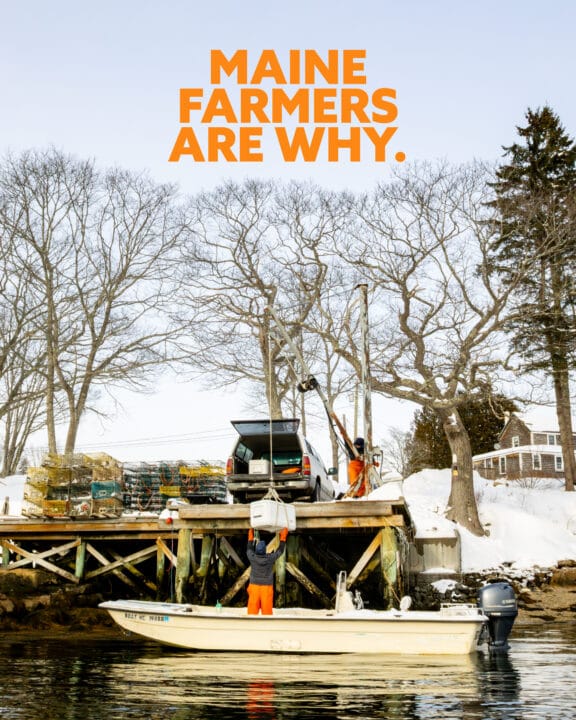 FareWell Oysters unloads their shellfish at a working waterfront in South Bristol. South Bristol is home to several sea farms and is one of the Maine towns considering an aquaculture moratorium.
Photo: Jack Sullivan, Maine Aquaculture Association
